HOUSTON, Texas — Four volunteers who have spent an entire year living inside a simulated Mars habitat are preparing to return to everyday life after taking part in one of NASA’s most ambitious experiments designed to understand the challenges of sending humans to the Red Planet.
The crew marked its one-year anniversary on October 19, having spent 365 days isolated inside a specially constructed habitat at NASA’s Johnson Space Center in Houston. The mission, known as Crew Health and Performance Exploration Analog (CHAPEA), is designed to recreate many of the physical, psychological and logistical challenges astronauts could face during extended missions to Mars.
The four-person crew includes mission commander Ross Elder, medical officer Ellen Ellis, science officer Matthew Montgomery and flight engineer James Spicer. The volunteers entered the habitat on October 19, 2025, beginning a 378-day assignment scheduled to conclude October 31, 2026.
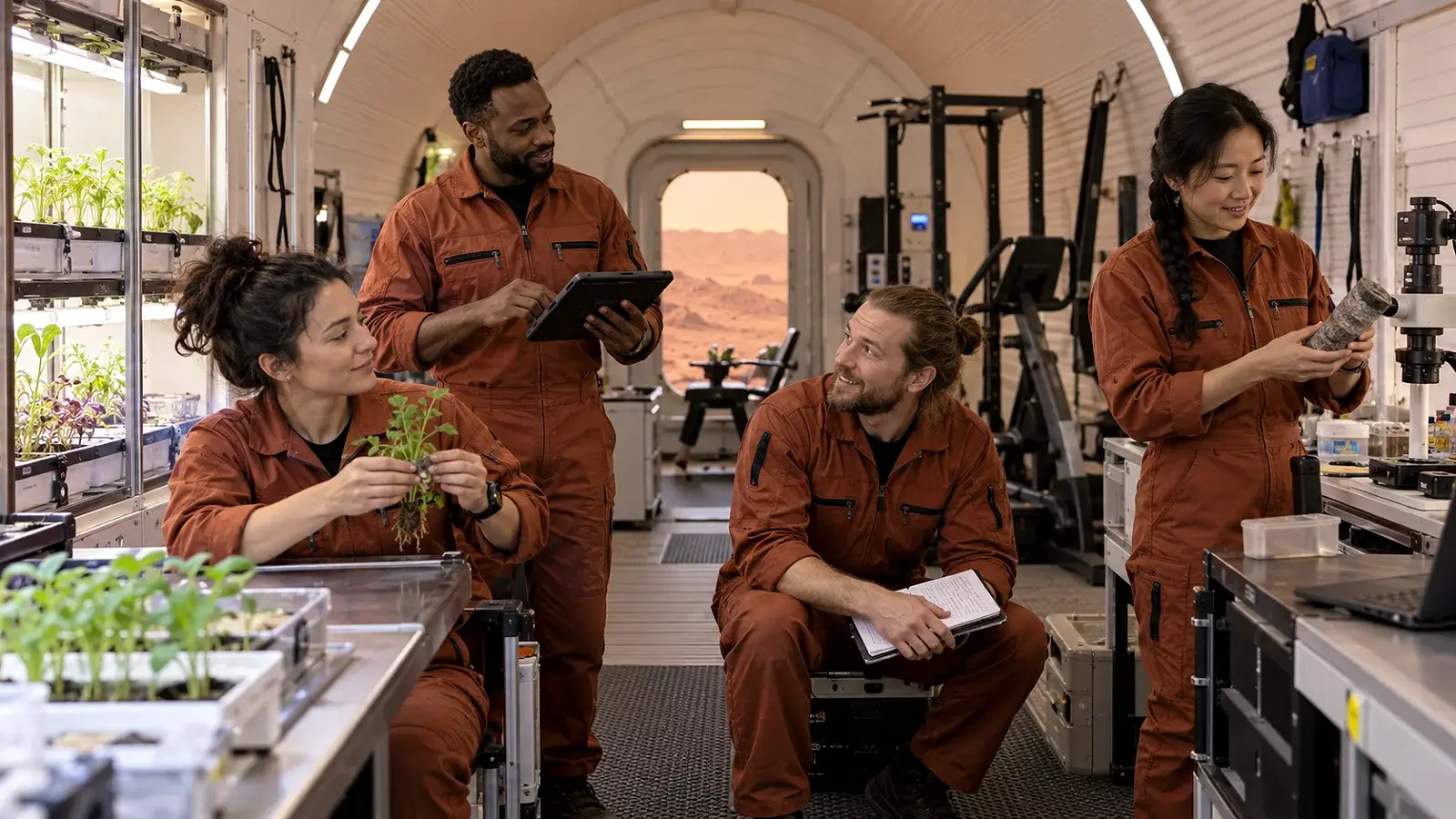
Their home for the past year has been Mars Dune Alpha, a roughly 1,700-square-foot, 3D-printed structure designed to simulate living conditions on the Martian surface. The facility includes private sleeping quarters, a kitchen, medical and recreation areas, exercise equipment and spaces dedicated to scientific experiments and growing crops.
Life inside the habitat involves far more than simply staying indoors. Crew members have maintained equipment, conducted scientific research, grown food and performed simulated spacewalks while working within restrictions intended to resemble those astronauts would face millions of miles from Earth.
Communication has been another significant challenge. Unlike astronauts aboard the International Space Station, who can communicate with mission controllers relatively quickly, the simulated Mars crew experiences communication delays of up to 22 minutes. Those delays mean even routine conversations with people outside the habitat can require considerable patience and planning.
The volunteers have also experienced the emotional challenges of being separated from family and friends. Throughout the mission, their contact with loved ones has been limited to delayed email communication. NASA researchers are studying how prolonged isolation, demanding schedules and restricted communication affect the crew’s physical health, mental well-being and ability to work together.
Food and resource management have been central parts of the experiment. On an actual Mars mission, astronauts would not have the luxury of frequent resupply shipments from Earth. Researchers are examining how crews manage limited supplies, maintain nutrition and balance everyday responsibilities with demanding scientific assignments.
The experiment also helps NASA evaluate how astronauts might respond when equipment fails or unexpected problems interrupt their routines. On Mars, a crew would need to solve many challenges independently because immediate assistance from Earth would be impossible.
NASA principal investigator Grace Douglas praised the volunteers for completing a demanding year of simulated exploration. The agency says information collected during the mission will help researchers develop strategies to reduce the health and performance risks associated with long-duration space travel.
The volunteers are scheduled to emerge from the habitat on Saturday, October 31. After reuniting with their families, they will undergo approximately two weeks of post-mission medical evaluations, interviews and scientific assessments. Researchers will compare the information gathered during isolation with findings collected after the mission ends.
This is NASA’s second CHAPEA mission. The first began in June 2023 and concluded in July 2024. Together, the experiments are intended to provide scientists with a better understanding of the challenges humans could face while living and working on another planet.
Although NASA has successfully sent robotic explorers to Mars for decades, sending astronauts presents a much more complicated challenge. Future crews would need dependable life-support systems, adequate food supplies, medical resources and the psychological resilience to spend extended periods away from Earth.
The findings from these simulated missions could influence how future spacecraft and habitats are designed, how astronauts are trained and how mission planners prepare crews for emergencies. For NASA, understanding how people function in isolation is as important as developing the rockets and technology necessary to reach Mars.
As the October 31 exit date approaches, the four volunteers are nearing the end of an unusual journey: spending more than a year pretending to live on another planet so that future generations of astronauts may one day be able to do it for real.